From the paper
Why atomistic polariton transport is expensive
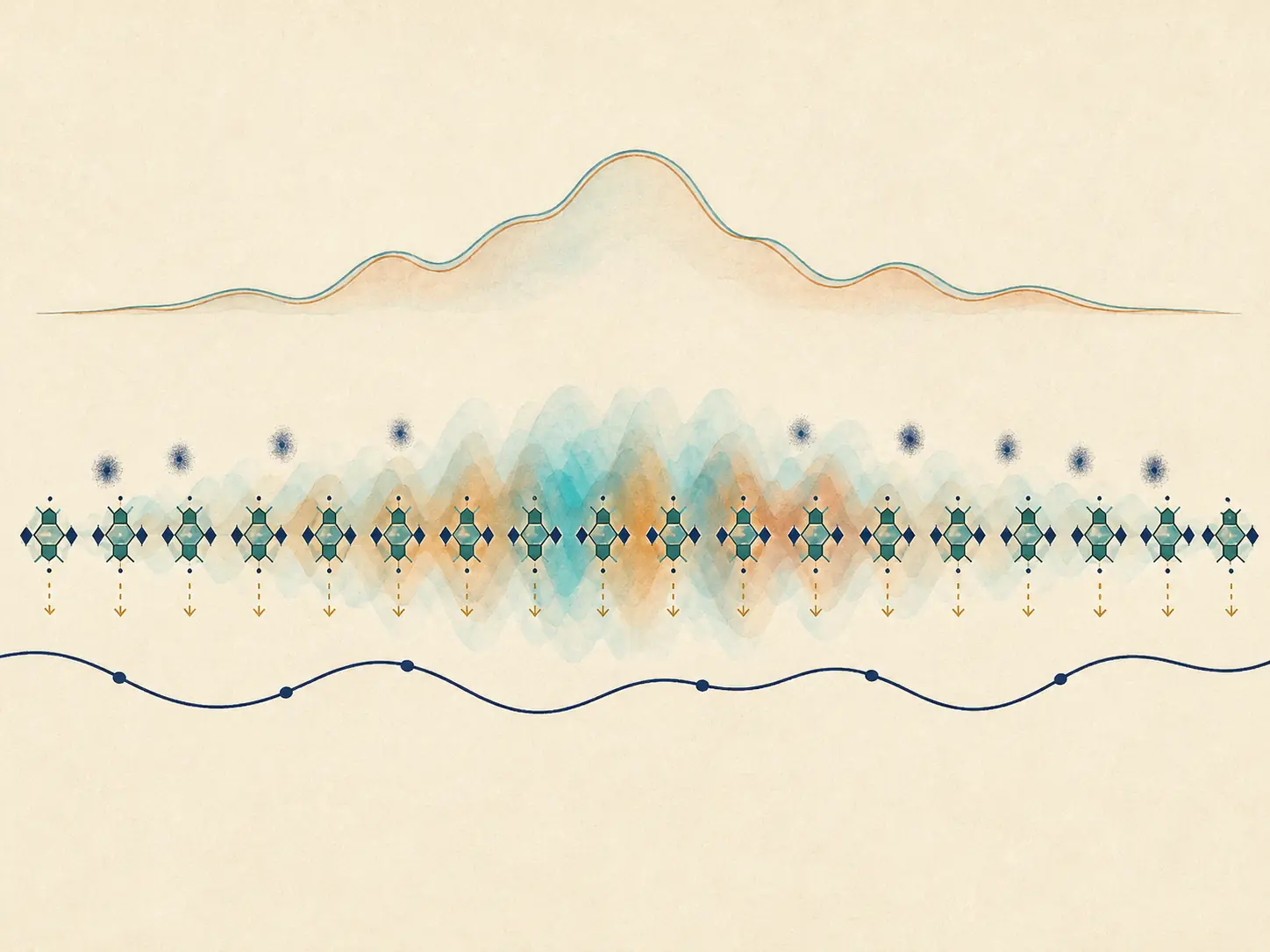
On-the-fly excited-state gradients for every molecule become prohibitive in a large cavity ensemble. The paper combines quantum exciton-photon propagation with precomputed ground-state Born-Oppenheimer trajectories, arguing that collective delocalization suppresses each molecule’s excited-state force correction.
From the paper
The classical path approximation
For a local harmonic bath coordinate, the full mean-field and CPA forces have the structure
If the wavepacket is delocalized over an effective number of molecules $N_{\mathrm{eff}}$, then $|c_n|^2\sim1/N_{\mathrm{eff}}$ and the omitted local correction becomes small. The inverse participation ratio provides a practical diagnostic:
From the paper
From model validation to BODIPY transport
- Propagate exciton and photon amplitudes with Lindblad mean-field dynamics.
- Validate CPA against full mean-field forces in a generalized HTC model using velocity, MSD, populations, and spatial wavepackets.
- Generate ground-state molecular trajectories and electronic properties for immobilized BODIPY molecules.
- Feed time-dependent excitation energies and dipoles into the quantum propagator.
- Compute transmission, polariton/dark density, and transient MSD, then compare their trends with experiment.
- Ground-state pathsObtain affordable nuclear trajectories and molecular observables.
- Quantum propagationEvolve the coupled exciton-photon wavepacket with loss.
- Adaptive checkRequest local excited-state gradients only where population becomes large.
Simplified educational example
How delocalization controls the omitted force
For a uniformly delocalized wavepacket, the omitted local force is $|C|/N_{\mathrm{eff}}$. Increasing $N_{\mathrm{eff}}$ from 1 to 1000 lowers that per-molecule correction by three orders of magnitude.
Python participation-ratio diagnostic
import numpy as np

x = np.arange(400)
for width in (1.5, 8.0, 30.0, 100.0):
    p = np.exp(-0.5*((x-200)/width)**2)
    p /= p.sum()
    N_eff = 1.0/np.sum(p**2)
    omitted = p.max()  # in units of |C|
    print(width, N_eff, omitted)
From the paper
Reported validation and application
- CPA and full-force model simulations agree closely for group velocity, transient MSD, populations, and spatial wavepackets across the tested losses and bath couplings.
- The agreement is explained by collective delocalization rather than treated as an empirical accident.
- The atomistic BODIPY calculation reproduces the cavity anti-crossing and qualitative transient transport behavior seen experimentally.
- The paper proposes an adaptive extension that evaluates excited-state gradients only for molecules whose local excitation probability exceeds a threshold.
Scope and breakdown conditions
When CPA may fail
- Localized initial states, strong static disorder, dark-state localization, or bond-localized photochemistry can make $|c_n|^2$ large.
- The study is restricted to a single excitation; higher manifolds increase force corrections with excitation number.
- Derivative couplings and nonradiative relaxation terms are neglected for the ultrafast transport window.
- The atomistic electronic structure is semiempirical, molecular centers are fixed, and only five atomistic realizations are propagated.
- Nuclear motion remains classical and the comparison to experiment is mainly qualitative or semiquantitative.