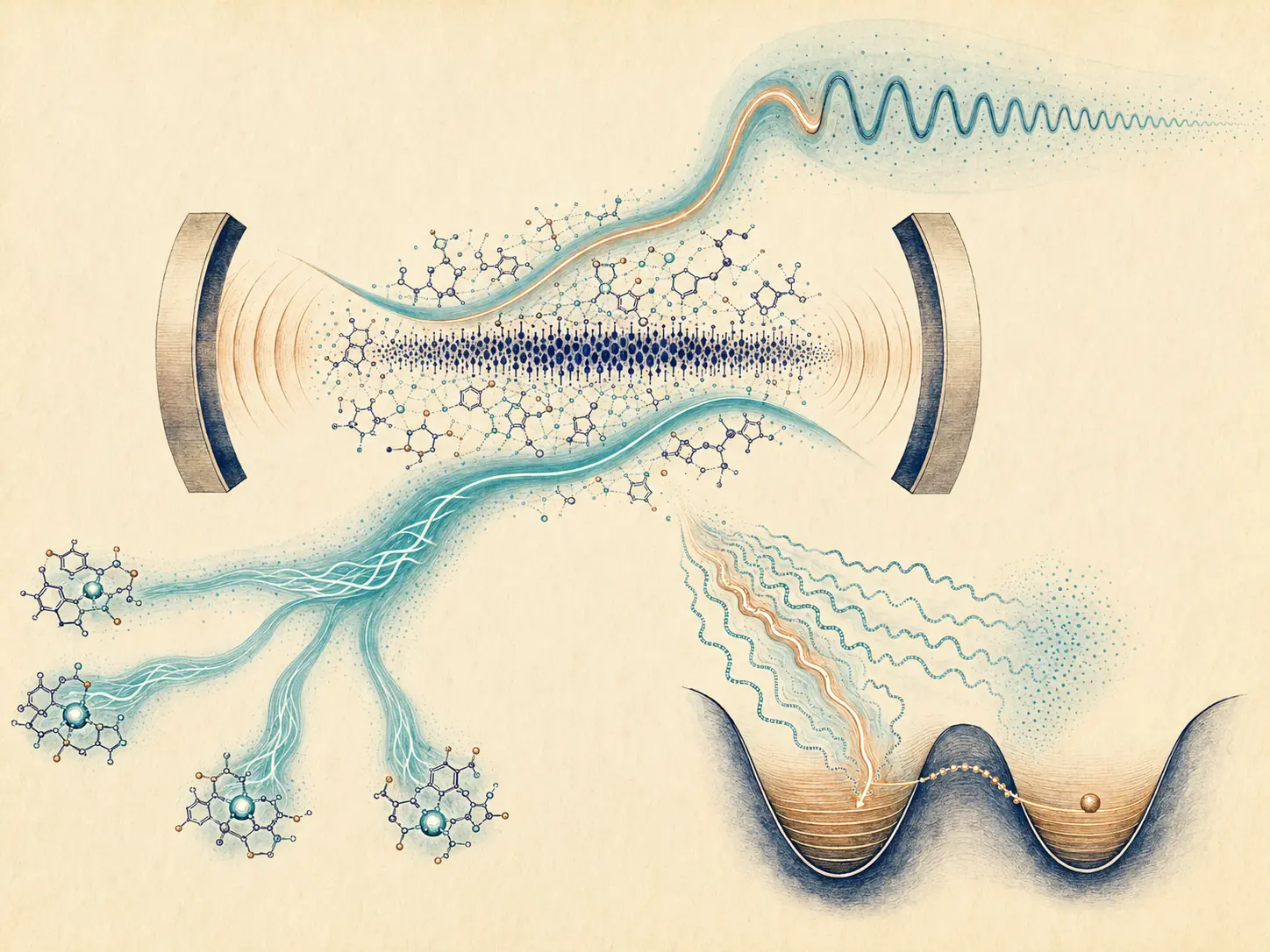
Review synthesis
Collective coupling changes more than the Rabi splitting
One bright exciton hybridizes with the cavity photon, while $N-1$ dark combinations remain. Collective physics arises through several quantities at once:
The same $1/\sqrt N$ bright-state amplitudes that suppress local bath displacement coexist with an $N-1$ dark-state degeneracy. Detuning, disorder, bath spectrum, and cavity loss decide which scaling dominates an observable.
Review synthesis
Relaxation, coherence, and spectra
Upper and lower polaritons can relax into the dark manifold with degeneracy-enhanced rates. Larger splitting may move these transitions away from bath frequencies and create a phonon bottleneck, while cavity loss ultimately limits coherence. Polaron decoupling narrows the matter contribution to the linewidth, but a simple Hopfield-weighted average misses the nonlinear dependence on $N$ and upper-to-dark scattering.
Review synthesis
Polariton-mediated electron transfer
For $N$ local donor-acceptor pairs, the coupling from one polariton to any specific acceptor is diluted by $1/\sqrt N$, but there are $N$ acceptor destinations. Summing their rates cancels the naive $1/N$ penalty. The polariton energy changes the effective driving force in a Marcus-like rate, while loss and dark-state trapping compete with transfer.
Review synthesis
One model mechanism for ground-state VSC chemistry
In an energy-diffusion-limited double-well model, cavity hybridization splits spectator-mode spectral weight away from the transition frequency and reduces energy flow into the reaction coordinate. The resulting effective spectral density explains a sharp resonance and collective scaling in that symmetric model. The inferred $-k_BT\ln(k/k_0)$ is an effective kinetic quantity, not necessarily a changed equilibrium barrier.
- PhotophysicsPolaron decoupling, dark-state rates, coherence, and linewidths.
- Electron transferCollective destinations offset single-channel dilution.
- VSC chemistryCavity reshapes the spectral route for vibrational energy flow.
Simplified educational example
Two competing collective trends
For $g_c=2$ meV and molecular $\lambda=50$ meV, $N=1,25,100$ give Rabi splittings 4, 20, and 40 meV, while $\lambda_N$ falls from 12.5 to 0.5 to 0.125 meV. The bright-state displacement shrinks rapidly even as the dark manifold grows.
Python collective scaling
import numpy as np

N = np.array([1, 25, 100])
gc, lam = 2.0, 50.0  # meV
Omega_R = 2*np.sqrt(N)*gc
lambda_pol = lam/(4*N)
print(np.c_[N, Omega_R, lambda_pol])
Review perspective
What remains unsettled
- This article synthesizes primary literature; individual numerical results belong to the cited original studies.
- Many analytic expressions begin with identical aligned emitters, one cavity mode, rotating-wave coupling, and weak perturbative rates.
- The polariton-mediated electron-transfer model is intentionally minimal and does not cover every photochemical reaction.
- The VSC energy-diffusion mechanism depends on symmetric mode-reaction coupling and can be weakened by disorder.
- Competing theoretical mechanisms remain, so direct experimental tests of scaling, detuning, and disorder predictions are essential.