Theory proposed in the manuscript
Move beyond a single-excitation polariton picture
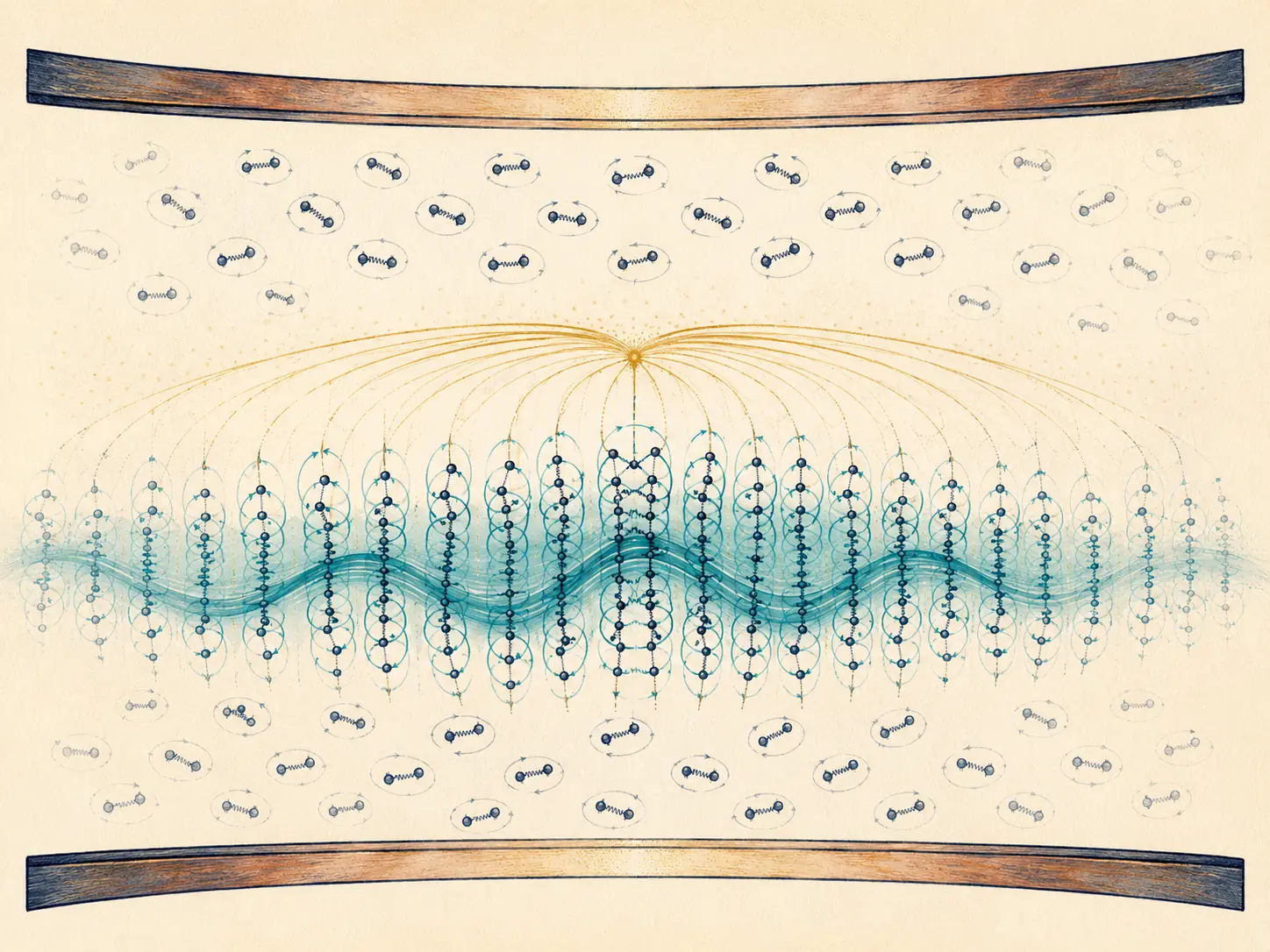
Dark vibrational strong-coupling experiments report rate and equilibrium changes without optical pumping. The manuscript proposes that cavity-mediated all-to-all interactions among many thermally occupied vibrational transitions can support a macroscopic correlated state, rather than relying on occupation of one bright polariton. This is a theoretical mechanism under investigation, not an experimentally established condensate.
From the manuscript
Eliminate the photon to obtain collective vibrational exchange
Starting from a Tavis-Cummings Hamiltonian, a second-order Schrieffer-Wolff transformation gives
The vibration is truncated to its two lowest levels, so the excitations obey hard-core-boson algebra. The shared cavity generates an exchange graph connecting every vibration to every other vibration.
From the manuscript
BCS-like variational construction
A chemical potential fixes the thermal excitation number. Self-consistent amplitudes $u_n$, $v_n$, gaps $\Delta_n$, and $\mu$ are obtained by fixed-point iteration with mixing and bisection. Frequency and orientation disorder determine what fraction of vibrations can participate near resonance.
- Cavity eliminationGenerate an effective all-to-all vibrational interaction.
- Trial stateMix empty and occupied hard-core vibrational states coherently.
- Self-consistencySolve the gap and number equations together.
Simplified educational example
Evaluate the proposed homogeneous threshold
The manuscript’s simplified threshold can be written
With $\omega_0=1000$ cm$^{-1}$, $k_BT=208$ cm$^{-1}$, and detuning 1 cm$^{-1}$, the critical value is $\Omega_{R,\mathrm{crit}}\approx69.5$ cm$^{-1}$. In this homogeneous teaching estimate, 50 cm$^{-1}$ is below and 80 cm$^{-1}$ is above the threshold.
Python threshold calculation
import numpy as np

omega0, kBT = 1000.0, 208.0  # cm^-1
detuning = np.linspace(0.05, 10.0, 300)
critical = np.sqrt(4*detuning*(omega0+kBT))
print(np.sqrt(4*1.0*(omega0+kBT)))
Predictions proposed in the manuscript
Consequences of the macroscopic-state picture
- A critical collective coupling that increases with temperature, vibrational frequency, and detuning.
- A finite resonant participation fraction when vibrational frequencies are disordered.
- A phenomenological rate-suppression factor $k/k_0=\exp[-|\Delta_n|/(k_BT)]$ and threshold-like dependence on Rabi splitting.
- Possible connections to equilibrium changes and cooperative solvent-reactant VSC through a shared correlated state.
- Renormalization of the threshold by local dissipative baths rather than automatic destruction of the proposed state.
Important theoretical cautions
Open questions and validity conditions
- The Schrieffer-Wolff elimination requires $|g_n/\delta_n|\ll1$, while the strongest proposed effects occur near resonance.
- Two-level vibrational truncation, rotating-wave coupling, and omission of full Pauli-Fierz terms limit the microscopic model.
- The all-to-all interaction and its thermodynamic normalization require careful interpretation.
- The simple rate expression predicts suppression; reaction-specific enhancement is not quantitatively developed.
- The supplied manuscript contains unresolved supplementary cross-reference placeholders. Direct equation-to-SI links should wait for a corrected source.